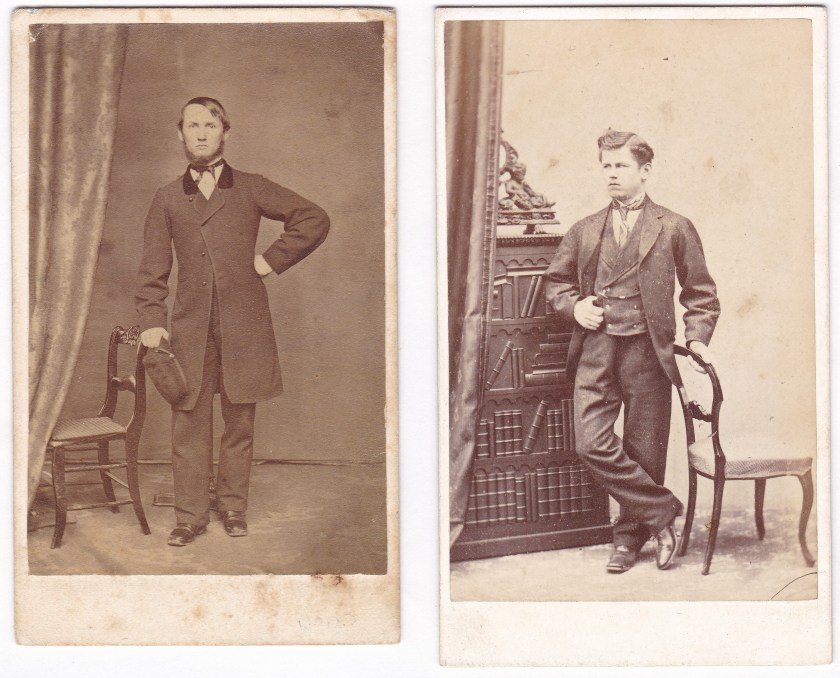
Young men leaning on chairs
By: usermattw
Tags: antiques, Cambridge, CDV, photography, Toledo, vintage photography
Category: Men
Click here to view it larger.
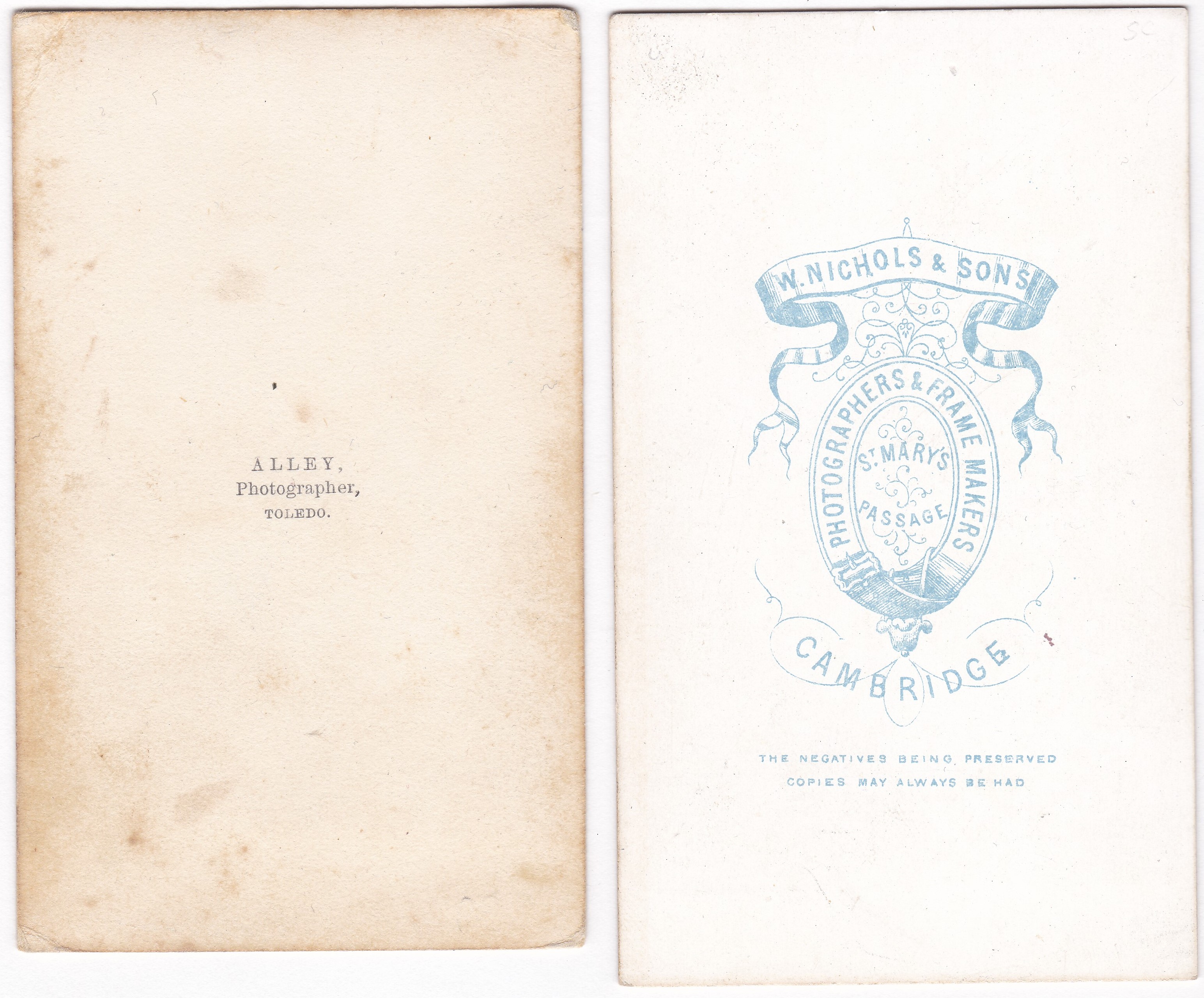
I like each of these little carte de visite images separately, but when I looked at them side by side, my attention was drawn to the way the juxtapositions of their bodies to the furniture gives the impression of a height difference, which is why I decided to share them together. Is the man on the left actually taller than the man on the right, or has he been given a smaller chair to pose with? He appears to be leaning over a bit, so maybe they didn’t have a taller chair, though perhaps that lean was the desired effect all along. The cabinet on the right adds to the effect that the man on the right is shorter, but I still wonder. Both are perfectly fine portraits, so at the end of the day it doesn’t really matter. On a separate topic, I noticed that the man on the left is holding a hat that looks a bit like a soldier’s hat, though the rest of his outfit doesn’t appear to be a uniform. If so, is this perhaps a formal civilian portrait that nevertheless nods to his service? Below are the backs [click to enlarge]. The one on the left, which I’m guessing is the older of the two photos, simply says “Alley, Photographer, Toledo”. I suspect that’s Ezra H. Alley of Toledo, Ohio. The one on the right is W. Nichols & Sons of Cambridge, England. I found an article on Alley here and an article on Nichols here, both of which speculate that these photographers were the first photographers in their respective towns.

 Pics of Then
The man on the left is definitely taller than the fellow on the right, although exactly how tall is hard to say. The hat is rather curious.
I own at least one cdv by William Nichols, so I enjoyed reading the article you found. I also have one by A. Nicholls of Post Office Terrace, Cambridge. That could be one of his sons, although the name is spelled differently and the studio is at a different address.
Oh, how fun that you own one, too! Sometimes when I search online for information or other examples of a photographer’s work, I’m amazed by how much or how little I find, and it makes me wonder why. Were they well-regarded and prolific in a long career such a volume of their output lasted, or was it a quirk of fate that future generations have paid attention to their lives and held on to their work?
I know what you mean. I’m convinced that the information available online is just a small fraction of what exists in public and private archives, especially local historical societies. On the other hand, some photographers probably didn’t operate long enough to leave much of a mark.
Here’s my cdv by William Nichols. (It has the eBay seller’s watermark). I bought it because I liked the piano: https://tokensofcompanionship.blog/wp-content/uploads/2024/08/woman-with-small-piano-in-cambridge-by-w.-nichols-1f.jpg
Oh, yes, I love that picture, too. A piano is an unusual studio prop, but it seems like such an obvious choice for conveying cultured refinement. I guess it’s cumbersome, though, assuming it’s real.
Not only are loads of photos hidden away in attics and archives, there are plenty that don’t even have the photographer identified, or have had that information trimmed off. Later examples I found online from Abbey of Toledo (the one on the left) show a more elaborate design on the back, with the photographer’s full name. I was lucky this one has as much as it does.